

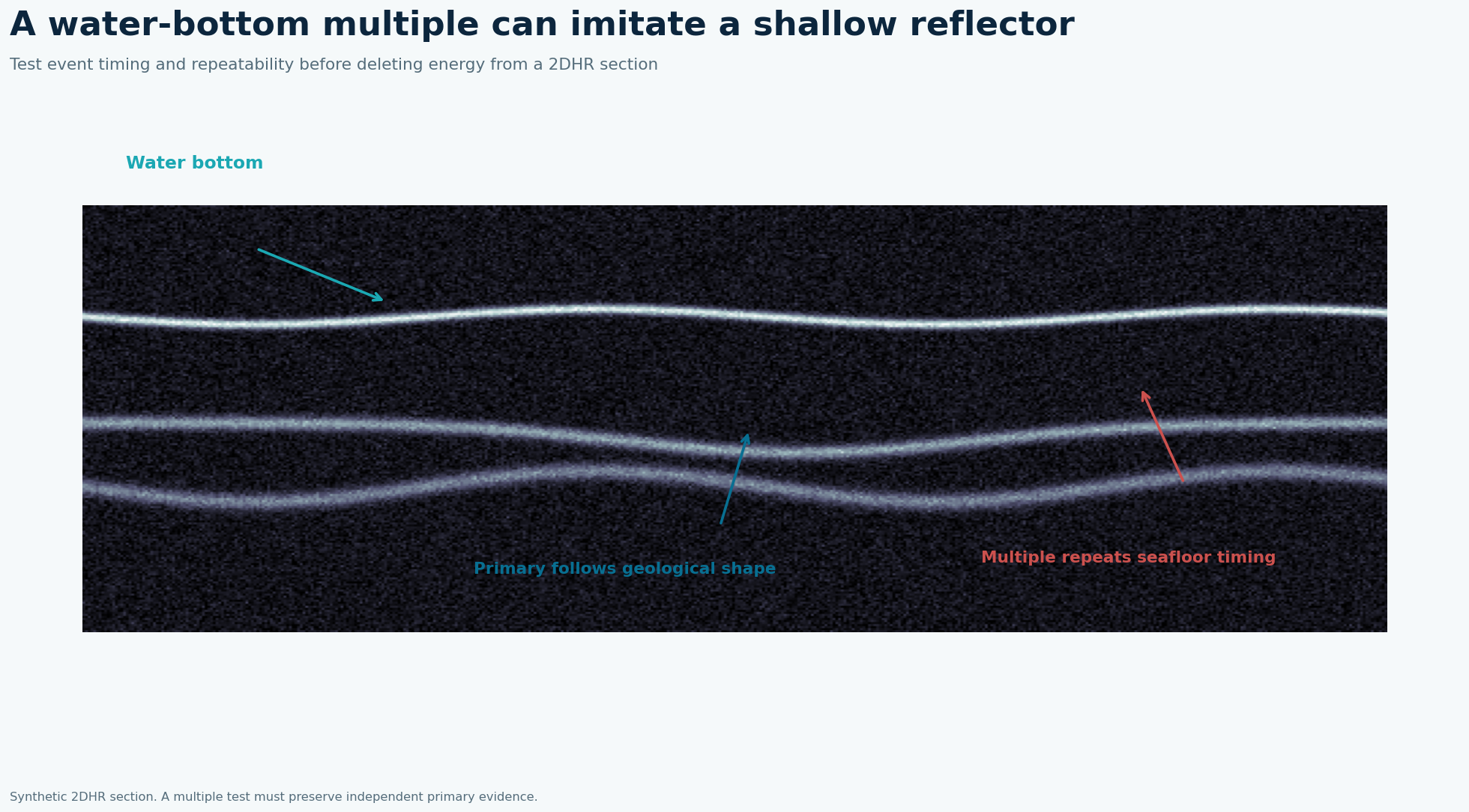
Literature-based case study | shallow water 2DHR seismic multiples. How can an offshore-wind site team tell a shallow multiple from a real buried interface?
The practical question
In very shallow water, repeated reflections can overlap the useful early-time window. Aggressive filtering may create an attractive section but remove primary events that matter for foundation interpretation. A reported improvement in one dataset is evidence that processing can help, not a guarantee that the same parameters fit another source, receiver or seabed.
What the published data actually say
A published Fangchenggang survey covered 99 km² in 0–25 m water depth. Its processing workflow reported about 8–12 dB signal-to-noise enhancement, roughly 2.5-fold better traced horizon continuity, and removal of more than 70% of multiple energy within the targeted range. Source: Scientific Reports 2026, Fangchenggang single-channel seismic workflow. These are findings from that location and acquisition setup, not a GeoSubsea project or a universal equipment specification.
A defensible field-to-report solution
Preserve an untouched input and define representative lines crossing shallow and deeper water, seabed changes and known control points. Establish navigation, timing, geometry and source-signature QC before signal processing. Apply noise attenuation and multiple suppression in staged versions. Inspect common-scale input, intermediate and output sections; compare amplitude spectra, picked seabed and subbottom horizons, and a model of expected water-bottom multiple times. Tie the surviving events to SBP and borehole markers where available. Only migrate after deciding whether shallow dips or side echoes need it.
Worked decision example
A 10 dB SNR gain lies inside the published 8–12 dB range, yet SNR alone cannot show whether a weak primary survived. On a held-out line, track a known horizon through every processing stage and inspect the removed-energy panel. If the target reflector appears predominantly in the rejected energy, revise the operator before interpreting it as absent.
What to record in the field
Begin with a test panel whose water depth changes along line. Calculate the approximate first water-bottom multiple travel time from the observed seabed event and identify where the suspected multiple crosses the engineering horizon of interest. Inspect source signature, trace editing and noise before tuning an F-K or predictive subtraction operator. Keep a preserved raw version and a sequence of intermediate panels at fixed display gain. If the proposed technique changes an interpreted layer boundary, record which process first produced that change and whether a core or SBP tie supports it.
How to make the engineering decision
A practical acceptance review has three independent views: spectrum or residual-energy reduction, continuity of geological events, and the removed-energy panel. The Fangchenggang study's 8–12 dB and more-than-70% figures describe its own evaluated workflow. A different project should set its own criteria from calibration lines and known geology. A smoother event is not automatically the correct event: if the operator removes a weak primary together with the water-bottom multiple, retune or limit its application to the time and dip ranges where the model is defensible.
QC gates before accepting the interpretation
Report the line selection, processing parameters, source and receiver geometry, before/after panels at equal display gain, residual-multiple map and uncertainty of every picked horizon. Have an interpreter review one held-out line without knowing which version is the preferred output.
Limits and next action
The Fangchenggang results belong to that survey and its targeted time range; do not advertise 70% as universal multiple removal. For a project-specific decision, identify the required engineering tolerance, review the raw survey evidence and agree the validation method before acquisition or reprocessing.
Applied decision scenario
Suppose the processed 2DHR section shows a continuous shallow reflector exactly where the unprocessed data show a weak primary crossing a water-bottom multiple. Keep the raw, intermediate and rejected-energy panels aligned by shot point. Test whether the event survives a less aggressive subtraction and whether it ties to a crossing SBP line. A discontinuity after processing is not automatically geological. Conversely, a continuous event generated by smoothing is not automatically real. Present both hypotheses and mark the small interval where a core or an extra line would most efficiently separate them.
Questions to resolve before sign-off
Is a reported decibel increase enough to approve a 2DHR section? No. SNR depends on the windows selected. Use a consistent before-and-after calculation and disclose those windows. Inspect a known geological event and the energy rejected by processing. Better SNR paired with the loss of a thin primary is a failure for the engineering objective. How should an interpreter mark an uncertain horizon? Pick a continuous event only where phase and ties remain consistent. Use dashed intervals and confidence codes near residual multiples. Record alternative events if both are plausible. The deliverable should show where a horizon is measured, where it is inferred and where borehole control or re-acquisition would change the choice.
Related geophysical services
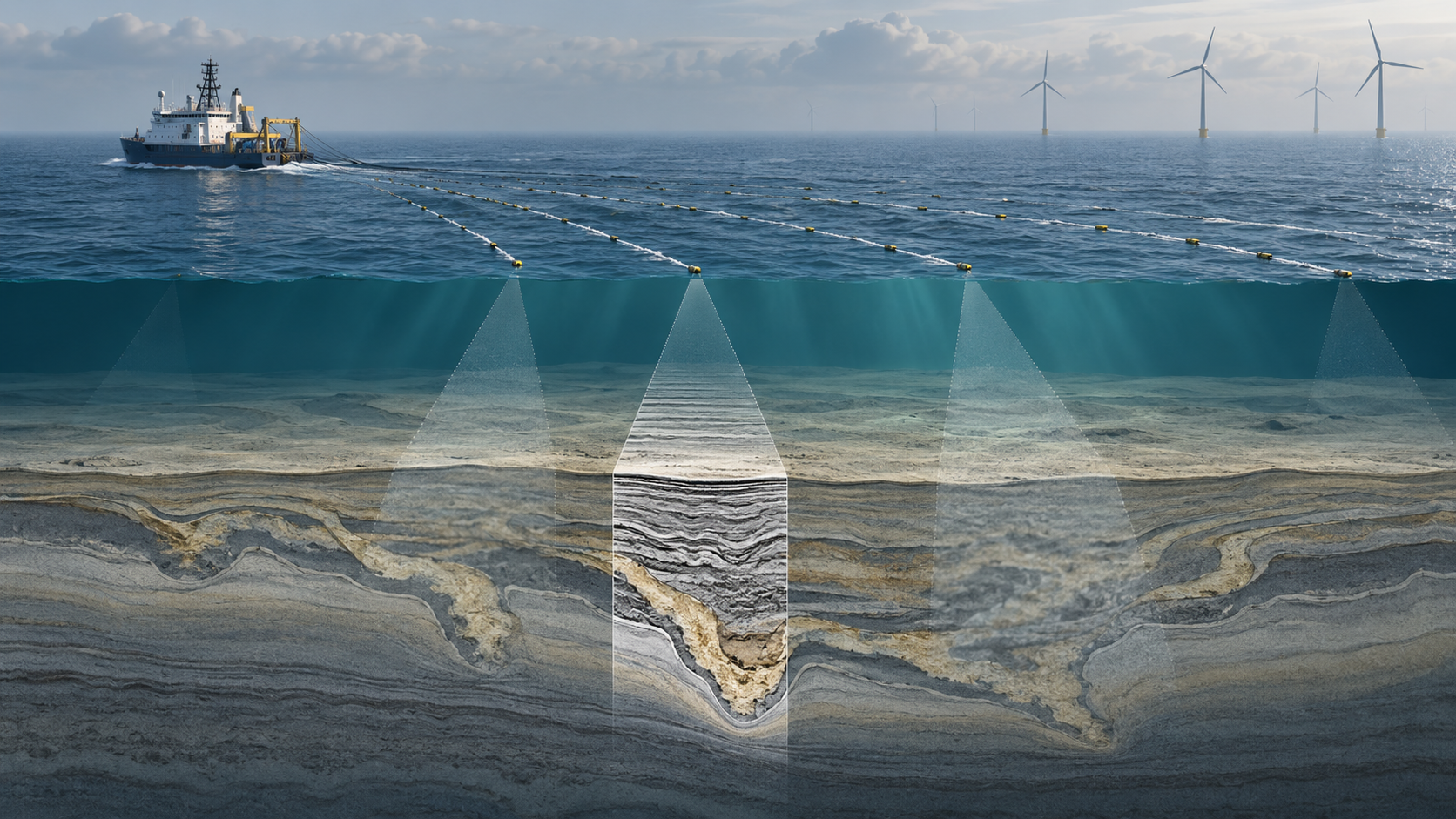
GeoSubsea supports integrated side-scan sonar, sub-bottom profiler, multibeam and high-resolution 2D seismic processing, survey QC and interpretation. For a defensible site-specific assessment, start with the survey objective, raw data, positioning records and ground truth.
Explore GeoSubsea services · More case studies
Primary reference
Scientific Reports 2026, Fangchenggang single-channel seismic workflow. The figures above are original editorial illustrations; they do not reproduce source figures.
Leave a Reply