
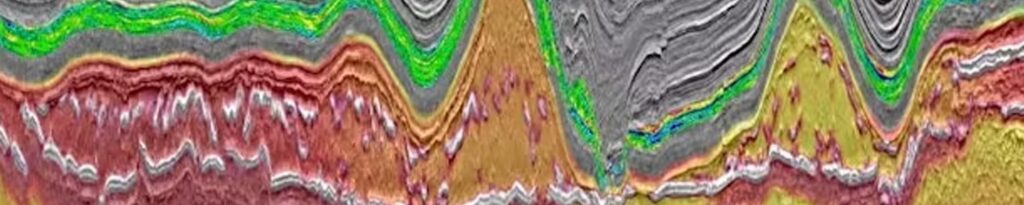
Revealing Seabed Features and Textures in Stunning Detail
At GeoSubsea, we specialize in Side Scan Sonar (SSS) data processing and interpretation to produce high-resolution acoustic imagery of the seabed surface.
SSS technology is essential for identifying seabed morphology, sediment texture, debris, boulders, wrecks, pipelines, and UXO-like objects, enabling our clients to plan, design, and execute offshore operations with confidence and precision.
Our experienced geophysicists utilize industry-leading software and advanced mosaicking algorithms to transform raw sonar data into seamless, geo-referenced imagery that provides both aesthetic clarity and engineering-grade accuracy.
Purpose and Application
Side Scan Sonar works by emitting acoustic pulses from transducers mounted on a towfish or hull-mounted system. These pulses are reflected back from the seabed surface, generating detailed images of seabed reflectivity (backscatter).
Because acoustic reflectivity varies with material composition, surface roughness, and object geometry, Side Scan Sonar imagery is a powerful tool for:
- Mapping seabed texture and sediment boundaries
- Detecting man-made objects, such as cables, anchors, wrecks, or pipelines
- Locating boulders, debris, and obstructions that could impact construction
- Supporting UXO (Unexploded Ordnance) surveys and marine archaeology
- Monitoring scour development around offshore structures
At GeoSubsea, we apply both automated algorithms and expert manual interpretation to extract meaningful insights from the sonar imagery — ensuring nothing is missed, no matter how small.
Our SSS Data Processing Workflow
Processing and interpretation of Side Scan Sonar data requires meticulous attention to calibration, geometry correction, and image enhancement.
Our workflow adheres to best practices under IHO, IMCA S006, and BSH standards, ensuring all processed mosaics meet engineering and navigational accuracy requirements.
1. Data Import and Initial Quality Control
- Import of raw sonar files along with navigation, altitude, and heading data.
- Verification of acquisition metadata such as range, frequency (typically 300–900 kHz), and towfish configuration.
- Inspection of raw sonar channels for dropouts, signal loss, and navigation offsets.
- Initial visualization to assess coverage, line spacing, and overlap.
This step ensures the data integrity and identifies any segments requiring reprocessing or exclusion.
2. Slant Range and Layback Correction
Raw sonar images often suffer from geometric distortion due to the varying distance (slant range) between the sonar transducer and the seabed, as well as the layback offset of the towfish behind the vessel.
To achieve spatial accuracy, we perform:
- Slant range correction to convert acoustic time to true ground range
- Layback correction using tow cable length and vessel navigation to realign tracklines
- Altitude normalization to maintain consistent sonar image geometry across varying depths
The result is a uniformly scaled image that accurately represents seabed features in their true horizontal positions.
3. Gain Normalization and Beam Balancing
Variations in sonar beam intensity can cause one side of the sonar swath to appear brighter or darker than the other. To correct this, GeoSubsea applies advanced gain normalization and beam balancing processes.
- Time-varied gain (TVG) adjustment to balance near- and far-range signal strength
- Radiometric correction to standardize pixel intensity
- Histogram equalization and dynamic range enhancement for image clarity
These corrections enhance the visibility of subtle textural differences and small targets across the seabed.
4. Geo-Referencing and Image Mosaicking
After corrections, each sonar swath is geo-referenced using high-precision navigation and motion data.
Individual swaths are then seamlessly combined through mosaicking algorithms to create a continuous, geospatially accurate image of the survey area.
- Overlap alignment and edge matching between adjacent lines
- Blending algorithms to ensure smooth transitions and consistent brightness
- Geo-referencing to project coordinate systems (WGS84, UTM, or client-defined grids)
- Export of final mosaic as GeoTIFF or raster layers compatible with GIS and CAD software
The resulting mosaic provides a visually stunning and analytically precise representation of the seabed, suitable for interpretation and engineering review.
5. Feature Detection and Target Analysis
One of the primary goals of SSS processing is to identify contacts — isolated features or objects that stand out from the background seabed.
GeoSubsea employs a combination of automated target recognition (ATR) and manual interpretation to detect and classify targets.
- Identification of objects such as boulders, UXO-like items, anchors, debris, wrecks, or cables
- Measurement of target height, shadow length, and orientation
- Categorization by acoustic reflectivity and morphology
- Assigning confidence levels (high, medium, low) for each detection
Each target is catalogued in a Contact Database, complete with imagery, coordinates, and descriptive attributes.
6. Sediment Texture and Seabed Classification
Beyond object detection, SSS imagery is also invaluable for understanding seabed texture and sediment distribution.
Our analysts integrate sonar backscatter patterns with MBES and grab sample data to classify seabed types such as mud, sand, gravel, or rock.
We apply gray-level co-occurrence matrix (GLCM) and texture-based segmentation techniques to map seabed variability with high spatial detail.
This information supports habitat mapping, scour risk assessment, and engineering foundation studies.
Deliverables
Upon completion, GeoSubsea provides a comprehensive deliverable package, tailored to the project’s purpose and client requirements:
- High-resolution SSS mosaics (GeoTIFF, PNG, or PDF)
- Contact charts with annotations and target IDs
- Target database in Excel, GIS shapefile, or AutoCAD format
- Seabed classification and sediment interpretation maps
- Technical report describing data processing steps, quality control, and interpretation results
Each deliverable undergoes internal peer review to ensure accuracy, consistency, and full compliance with international survey standards.
Integration with Other Geophysical Data
GeoSubsea integrates SSS imagery with complementary datasets such as MBES, SBP, UHRS, and Magnetometer to create a comprehensive view of the seabed environment.
When combined, these datasets provide a multilayered understanding of both the seabed surface and subsurface structure — essential for safe engineering design and risk mitigation.
Typical integrated applications include:
- Correlating sonar textures with MBES bathymetry
- Overlaying SSS contacts with magnetic anomalies
- Identifying geohazards near planned infrastructure routes
Why Choose GeoSubsea for Side Scan Sonar Services
- Proven expertise in offshore wind, UXO, and cable route SSS interpretation
- State-of-the-art software (SonarWiz, QPS, CARIS, and Global Mapper)
- Advanced noise filtering and contact detection techniques
- Deliverables fully compatible with GIS, CAD, and engineering systems
- Highly experienced interpreters familiar with IMCA and IHO standards
- Clear and visually polished presentation of all mosaics and charts
From Sound to Sight — Clarity Across the Seafloor
At GeoSubsea, we believe that every pixel tells a story.
Our Side Scan Sonar processing and interpretation services transform complex acoustic data into clear, actionable insights — helping engineers, scientists, and developers make informed decisions about the seabed they work on.
📧 Contact us today at info@geosubsea.com for sample mosaics or to discuss your SSS data processing requirements.